Kounkuey Design Initiative (KDI) was the co-lead of the Nairobi Risk Hub, 1 of the 4 (Nairobi, Quito, Istanbul and Kathmandu) original city hubs within the Tomorrow Cities Project. This interdisciplinary research hub works globally to bring multi-hazard disaster risk management to the center of urban policy and practice, facilitating a reduced disaster risk for the poor in tomorrow’s cities.
context
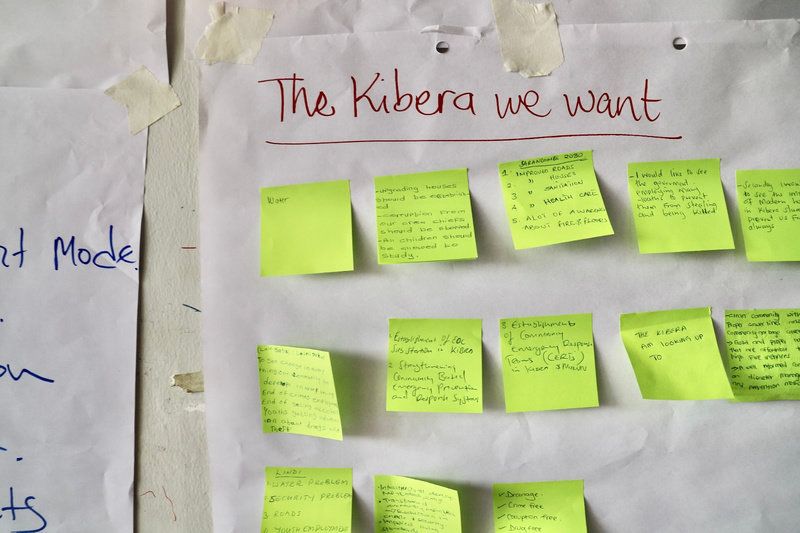
Aspirations of what Kibera could be like from residents.
The hazards, exposure, vulnerability, and “everyday risk” in Nairobi are concentrated in low-income and informal neighborhoods, where most of the population lives. Pro-poor urban design and planning in the context of Nairobi tomorrow is fundamentally a question of how to plan for the future of the city’s informal settlements, and how to integrate their residents and neighborhoods within the wider city-region and infrastructure. By studying the Mukuru Special Planning Area (SPA) process, a number of gaps were identified in the planning processes for informal settlements, such as the lack of risk information from local or technical analyses and lack of community feedback loops in implementation projects. We took this as an opportunity to use engagements with the Nairobi city government, Mukuru, and other informal settlements to inform and influence policy and SPA planning process at the local level, in the Kibera community, and the national level, through the country’s agenda for slum upgrading through the SPA model.
process
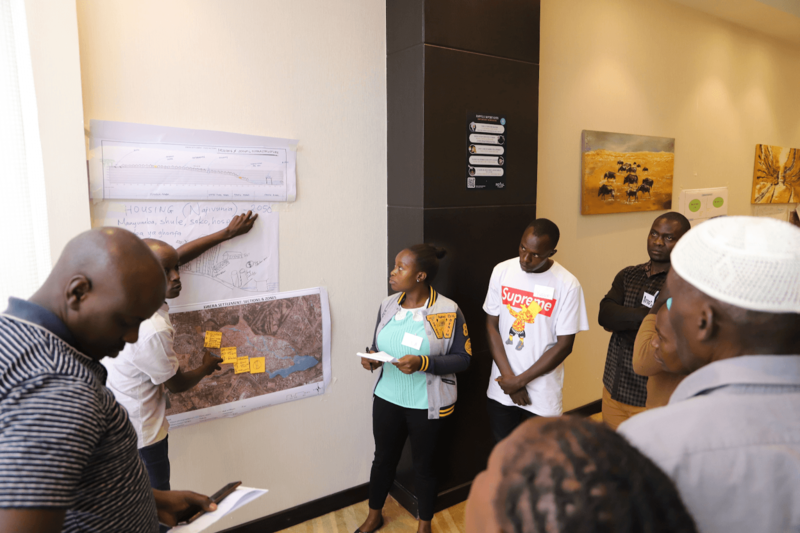
Presentations during a visioning session.
To test the Tomorrow Cities Decision Support Environment (TCDSE) tool, KDI coordinated developing a community-driven future visioning process for Kibera in 2030 and 2050. We structured the exercise around a set of prescribed scenarios developed by Rockefeller’s Informal City Dialogues in 2013 for Nairobi in 2040. Our process began by introducing Kibera residents from two cross-sections of the SPA wards to the four scenarios and building a foundational understanding of their terms and ideas.
This prescribed set of scenarios provided a good basis for visualizing Kibera in 2050, while still allowing residents to think outside the box. They even coined the term “hyena city.” This activity was most successful when we took a flexible approach, allowing participants to control their narratives as long as they tied them back to the central goal. Engaged and creative participation, like creating their own phrases, confirmed that participants clearly understood the figurative terms of this activity.
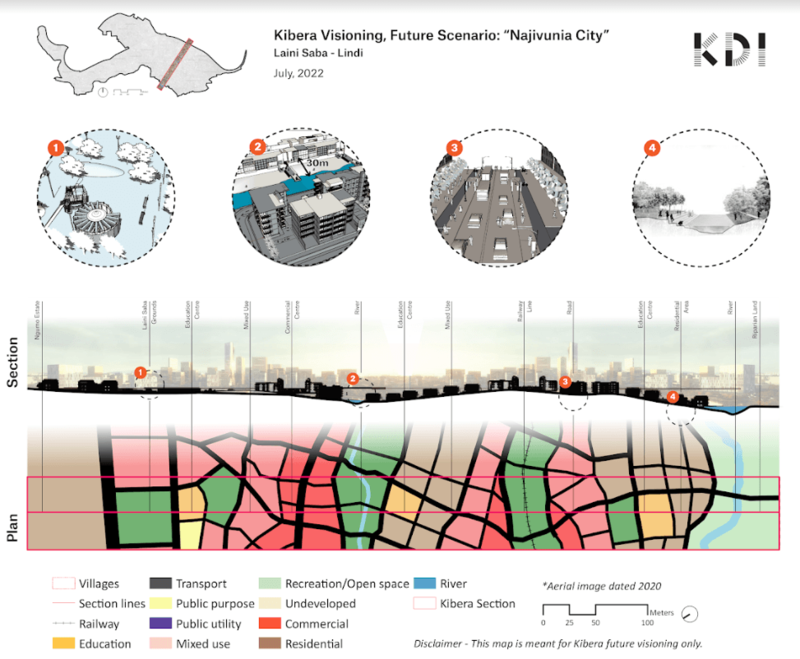
The scenarios were then populated with different variables identified with the TCDSE team responsible for the modeling. These variables included aspects like housing, social and physical infrastructure, economy, and environment. In one scenario, Kibera Najivunia, future Kibera focuses on climate change matters and invests in studies and mitigation efforts by business communities.
solution
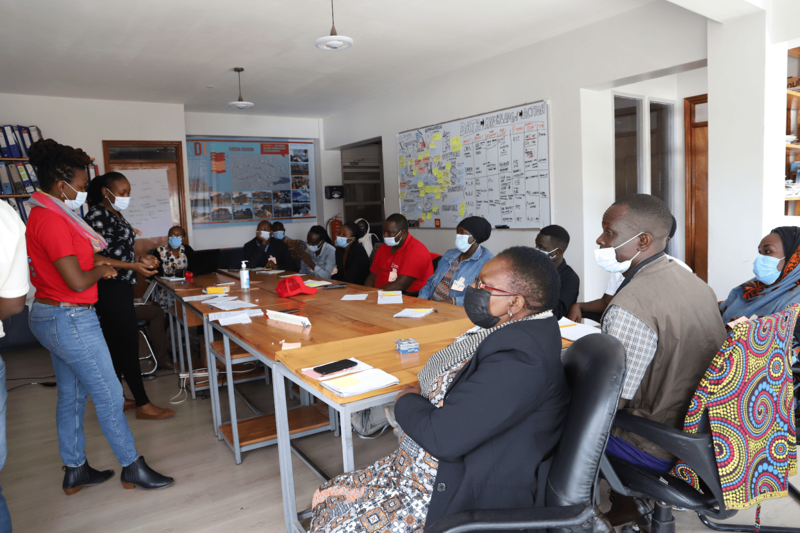
Photo of one of the initial engagements with different Kibera stakeholders.
These future vision workshops proved to be a great approach to a community-driven planning process, especially in the formulation of integrated development plans. Additionally, they can be used to meaningfully fulfill the community participation requirement of different legislative requirements. The team is using the Kibera visioning exercises to advocate for a similar process to be adopted in the preparation of plans for informal settlements, especially the ones that have been declared as Special Planning Areas. They are also being used to prompt conversations with Nairobi City County, consultants, and respective ministries on planning for informal settlements.
impact
KDI will share the visioning document with residents of Kibera, local and municipal stakeholders, and other social justice players within Nairobi. Although KDI’s work on the project has ended, the TCDSE is being further developed by the TCP team with partners in the host cities which have now grown to include two additional cities Nablus and Rapti. Additionally, the team has benefited from the experience of working with these new methods and have applied them in other work, including the Nairobi Urban Fabric Initiative, Kenya Informal Settlements Improvement Program Phase 2 (KISIP2), and Building Infrastructures of Climate Repair research project in Nairobi and Karachi.